Pearson Edexcel · GCSE · Psychology
Course version: 1PS0 · Version from Sept 2017
Understand factors affecting bystander intervention, including: a.…
Full specification wording
Social influence: 5.1.2 Understand factors affecting bystander intervention, including: a. personal factors b. situational factors
Bystander intervention is influenced by both personal and situational factors.
Checked against the Pearson Edexcel 1PS0 specification (opens in a new tab) on .
- Point 2 of 6
- 3 key terms
Study notes
From the checked teaching notes for this specification point.
The idea
Bystander intervention is influenced by both personal and situational factors. Personal factors relate to the individual's characteristics, such as their level of competence; a person trained in first aid is more likely to help a collapsed individual. Other personal factors include the bystander's mood or their perceived similarity to the victim. Situational factors relate to the environment and context of the emergency. A key situational factor is the diffusion of responsibility, where the presence of multiple people reduces the psychological burden on any single individual to act. Additionally, the ambiguity of the situation and the potential cost of helping, such as physical danger or time lost, can deter intervention.
What earns the marks
- Identify personal factors such as competence, mood, and similarity to the victim.
- Identify situational factors such as diffusion of responsibility, ambiguity, and the number of people present.
- Explain how diffusion of responsibility reduces the likelihood of intervention in larger groups.
- Apply knowledge of personal and situational factors to novel scenarios to predict bystander behaviour.
Common mistakes and how to put them right
Confusing personal and situational factors: Students often list diffusion of responsibility as a personal factor, but it is a situational factor dependent on the number of people present.
Overlooking competence: Forgetting that possessing specific skills, like medical training, is a major personal factor that increases the likelihood of intervention.
Misunderstanding diffusion of responsibility: Stating that people in crowds do not care, rather than explaining that the perceived responsibility is shared among the group, reducing individual action.
Exam tips
- When given a scenario, explicitly state whether the factor influencing the bystander's behaviour is personal or situational.
- Use the term 'diffusion of responsibility' accurately when discussing why people fail to help in crowded situations.
- Be prepared to evaluate how different factors might interact, such as a highly competent person helping despite a large crowd being present.
Try the lesson
The start of the Social influence: 5.1.2 Understand factors affecting bystander intervention, including: a. personal factors b. situational factors lesson, made from checked teaching notes for this specification point.
Have a go first
Which of the following is a situational factor that can affect whether a bystander intervenes in an emergency?
Listen
Bystander intervention is influenced by both personal and situational factors. Personal factors relate to the individual's characteristics, such as their level of competence; a person trained in first aid is more likely to help a collapsed individual. Other personal factors include the bystander's mood or their perceived similarity to the victim. Situational factors relate to the environment and context of the emergency. A key situational factor is the diffusion of responsibility, where the presence of multiple people reduces the psychological burden on any single individual to act. Additionally, the ambiguity of the situation and the potential cost of helping, such as physical danger or time lost, can deter intervention. A strong answer earns marks for these points. Identify personal factors such as competence, mood, and similarity to the victim. Identify situational factors such as diffusion of responsibility, ambiguity, and the number of people present. Explain how diffusion of responsibility reduces the likelihood of intervention in larger groups. Apply knowledge of personal and situational factors to novel scenarios to predict bystander behaviour. Exam tip: When given a scenario, explicitly state whether the factor influencing the bystander's behaviour is personal or situational.
See it

Key words
Say what each word means before you turn the card.
Personal factors
Try answering aloud or in your head before turning the card.
Situational factors
Try answering aloud or in your head before turning the card.
Diffusion of responsibility
Try answering aloud or in your head before turning the card.
See every definition
- Personal factors
- Characteristics of the individual, such as their level of competence, mood or perceived similarity to the victim, which influence the likelihood of helping.
- Situational factors
- Features of the environment and context of the emergency, such as diffusion of responsibility, ambiguity and the number of people present, which affect whether a bystander will help.
- Diffusion of responsibility
- A key situational factor where the presence of multiple people reduces the psychological burden on any single individual to act.
Label the diagram
Some boxes have lost their names. Pick the right name for each number.
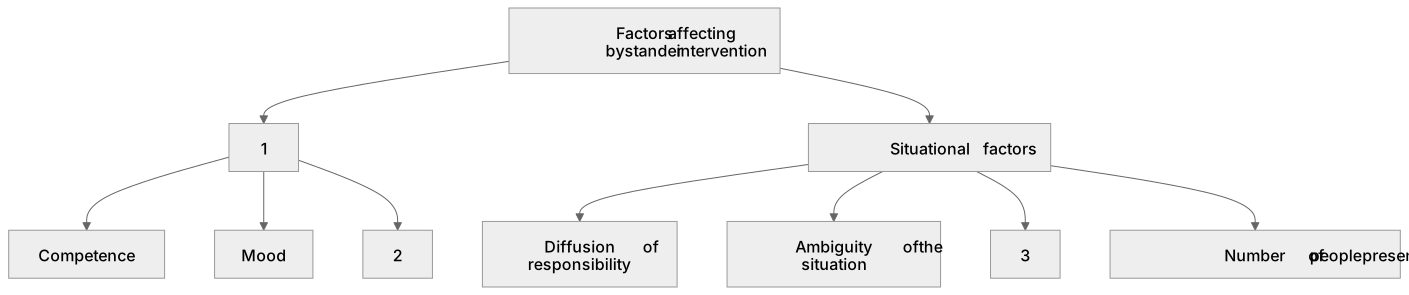
1Box 1
2Box 2
3Box 3
There is more to this lesson
The full lesson goes on to check your understanding and help you earn the marks. Create a free account to carry on, with your progress saved.
A week of Premium from your first lesson · Then the free plan continues · No card, no charge
Test your understanding of Social influence: 5.1.2 Understand factors affecting bystander intervention, including: a. personal factors b. situational factors
Active recall beats re-reading. Take an instant quiz now to test what you’ve learned and lock it into long-term memory.
A week of Premium from your first lesson · Then the free plan continues · No card, no charge